

Many well-intentioned efforts to support African governments stall at the point of execution. This is not because of a lack of need, but often because efforts are short-lived, externally driven, or disconnected from the realities of how government systems actually work. At Axum, we see this gap not as a failure of will but as proof that how partnerships are built matters as much as what they aim to achieve. Our African Government Collaborative (AGC) grows from that insight: lasting transformation depends on alignment, trust, and shared ownership. AGC offers a practical approach for how governments and their partners can work together more effectively. It is not ‘another project’, ‘initiative’, or a fixed model, but a way of engaging that builds momentum from within public systems rather than around them.
Understanding the Landscape: The Three Models of Government Engagement
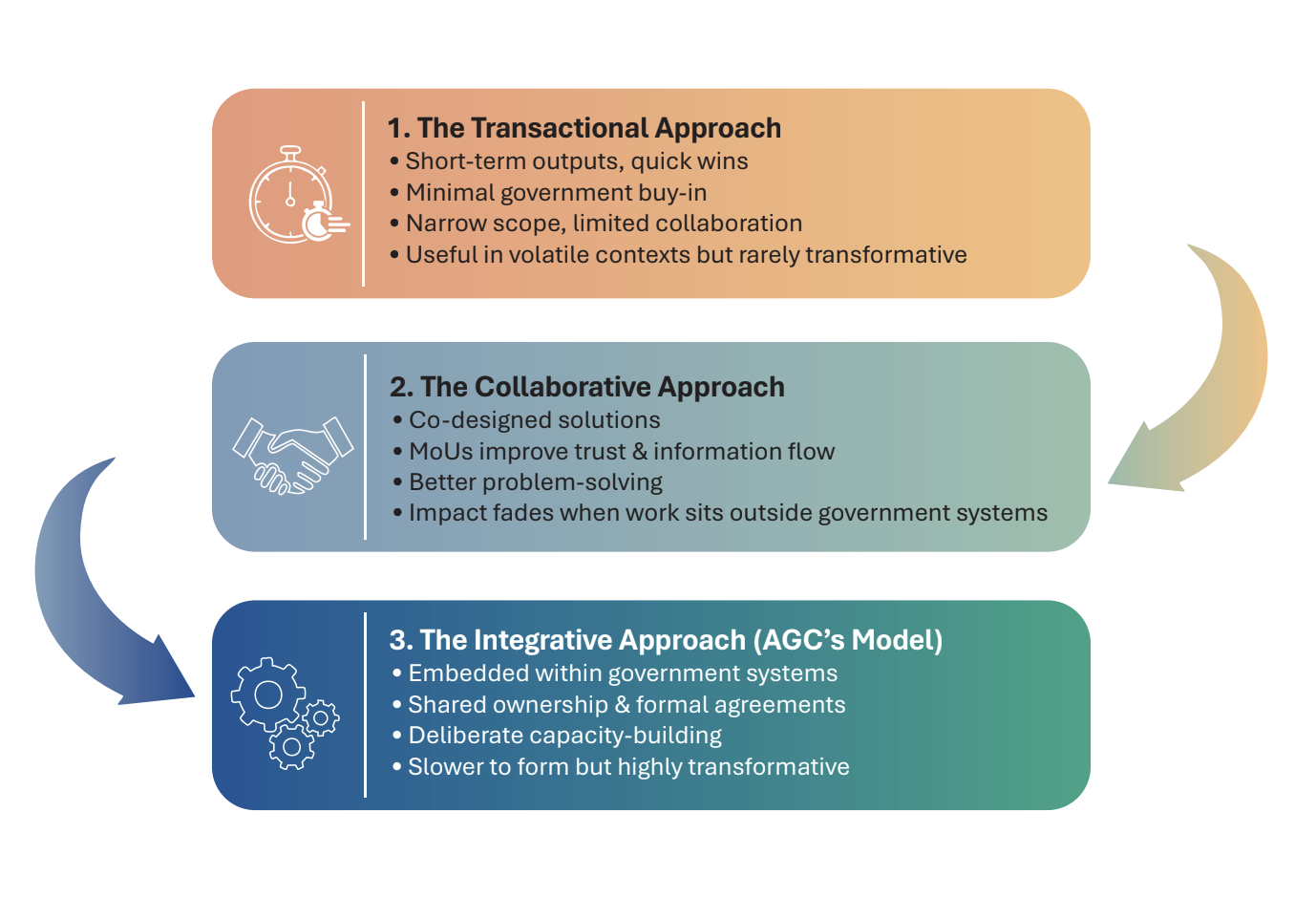
To understand what makes AGC distinctive, it helps to look at the spectrum of how development and advisory efforts engage governments today. Most fall into three broad categories.
- The Transactional Approach
Transactional partnerships focus on short-term outputs and quick wins, often with minimal government buy-in. They are the fastest and most common form of engagement, characterized by narrow scopes and limited collaboration. While this can be useful in volatile or high-turnover contexts, it rarely leads to lasting change. Projects end, reports are filed, and institutions return to business as usual. - The Collaborative Approach
Collaborative partnerships take a step forward. Solutions are co-designed and often formalized through Memoranda of Understanding (MoUs). Trust improves and information flows more easily, creating space for joint problem-solving. Yet challenges remain. When implementation sits outside government systems, results can fade once the external team exits, leaving little lasting capacity behind. - The Integrative Approach: AGC’s Ideal Model
AGC builds on an integrative approach that embeds partnership within government systems from the start. These partnerships are grounded in shared ownership, formal agreements, and deliberate capacity-building inside institutions. They take longer to build but are far more transformative.
The goal is not just to deliver a project but to align initiatives with national priorities, strengthen internal capabilities, and plan for transfer and long-term ownership from day one. Trust grows through transparency and accountability at every stage.
Not every context allows for full integration from the outset, but the ultimate aim is always the same: to move toward deeper, more embedded collaboration as conditions allow.
The AGC Solution: Design → Incubate → Transfer
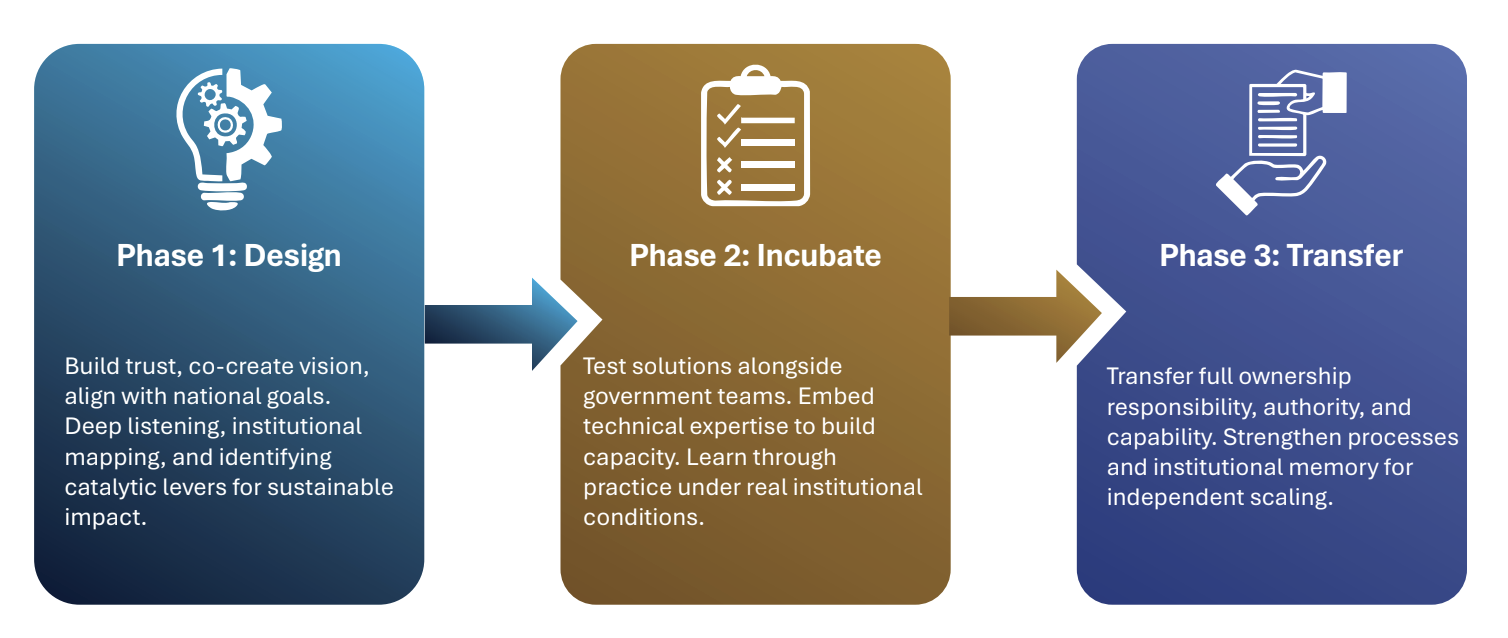
The Design–Incubate–Transfer (DIT) model, anchored in Axum’s DNA and reflected across all our initiatives, rests on the belief that durable change comes from co-creation, experimentation, and the gradual transfer of ownership.
Phase 1: Design
Each engagement begins with building trust and defining a shared vision. This phase involves deep listening, aligning with national goals, and mapping institutions and political incentives. Rather than bringing predefined solutions, AGC invests in joint problem definition and identifying catalytic levers for both quick and sustained impact.
Phase 2: Incubate
Solutions are tested side by side with government teams. Axum embeds technical expertise within ministries or agencies, offering hands-on support while investing in local capacity to adapt and improve. Learning happens through practice rather than training alone, ensuring that ideas work under real institutional conditions.
Phase 3: Transfer
The end goal is ownership. This phase focuses on transferring responsibility, authority, and full capability to government systems. It includes embedding skills, strengthening processes, and building institutional memory so governments can continue, adapt, and scale solutions independently. Throughout all three phases, trust, patience, and adaptability are essential. Sustainable change unfolds at the pace of institutional learning and political will, not donor timelines.
How AGC Builds Trust and Lasting Change
Through our work across Africa, four principles have guided how AGC takes shape in practice.

- Start with joint needs assessment and alignment
Every partnership begins by understanding government priorities and the outcomes they hope to deliver. By jointly identifying where support is most catalytic, AGC helps ensure that collaboration strengthens existing systems rather than creating new ones in parallel. - Target the right entry points
Change moves fastest when it starts in the right place. AGC emphasizes mapping institutions, understanding political realities, and finding champions who can unlock momentum. This enables governments and partners to work where reform is both needed and possible. - Foster government ownership
AGC focuses on co-designing programs that reflect local priorities and realities. This includes allowing space for flexibility and iteration, while prioritizing skill transfer so that capabilities remain long after technical support concludes. - Ensure continued collaboration
Trust is built over time through consistent engagement. AGC encourages partners to establish clear coordination mechanisms, regular check-ins, and open communication. This consistency turns transactional projects into enduring partnerships.
AGC in Action: Strengthening Tanzania’s Livestock and Fisheries Sectors
In Tanzania, AGC helped shape the creation of the Private Sector Desk (PSD) within the Ministry of Livestock and Fisheries. The PSD was established to strengthen sector performance by catalyzing private investment, advancing public–private dialogue, and improving the business environment through reduced bureaucratic bottlenecks and coordinated policy responses. To accelerate delivery, Axum embedded a dedicated advisor within the PSD to provide technical assistance, investment advisory, and hands-on support to private actors while bridging engagement between government and industry. Axum also worked with the PSD team to build institutional capacity in process design, partnership management, and results tracking. The PSD’s impact so far includes engagement with over 15,000 private-sector actors through training and opportunity promotion; facilitation of roughly US$80 million in loans annually for livestock and fish farmers; influence on tax reforms that reduced costs for producers; and mobilization of more than US$32 million in new investments in the livestock and fisheries sectors. This example shows how AGC helps governments lead reforms that are practical, scalable, and owned from within.
Toward Locally Led Transformation
As trust in traditional international development models continues to erode, AGC offers a pathway toward more equitable, locally led partnerships. It recognizes that sustainable change comes from within, and that the role of external partners is to support, strengthen, and eventually step back as government capacity grows. By helping governments take the lead in shaping their own development journeys, AGC illustrates what the future of effective collaboration in Africa can be—grounded in mutual respect, shared accountability, and long-term commitment. As part of this commitment, AGC launched earlier this year in Zanzibar, where the collaborative is already supporting government teams on priority delivery goals. For more information or to explore potential partnerships, please reach out to Jackson (Jackson.Mahenge@axum.earth) or Malik (Malik.Nkoba@axum.earth).